

Markets in a Minute – The Role of Bonds in Portfolio Construction
Championships Are Won Up Front
A month after the NFL Draft, the conversation is beginning to move beyond early headlines and toward long-term expectations. While the spotlight initially centered on skill positions, one theme remained consistent: teams continue to prioritize protection. Nine offensive linemen were selected in the first round this year, reinforcing a familiar pattern — successful teams invest heavily in the less visible parts of the game that ultimately determine outcomes over time.
The same idea applies to portfolio construction. Some of the most important parts of a portfolio are not always the most exciting. Bonds rarely get the spotlight, and after disappointing performance in 2022 they were easy to question. Their role is less about leading when times are good and more about supporting the portfolio when conditions get difficult.
In a well-built portfolio, fixed income serves four roles:
- Preserve capital across market environments
- Generate reliable income
- Provide diversification when risk assets reprice
- Reduce overall portfolio volatility
That role looks different today than it did a few years ago. With broad fixed income yields now around 5 percent, bonds are again well positioned to fulfill their role in portfolios.
When Diversification Gets Tested
For much of the past two decades, bonds have acted as a counterbalance to equities, particularly during growth-driven drawdowns. That relationship was strongest in a disinflationary environment where falling rates supported both prices and diversification. For investors, that matters because diversification can help reduce the impact of any single risk dominating portfolio outcomes, making it easier to stay invested through different market environments.
That backdrop shifted in 2022. Inflation became the primary risk, central banks tightened aggressively, and both equities and bonds repriced at the same time. Stock-bond correlations moved higher, and diversification became less reliable, as shown below.
Stock-Bond Correlation Has Shifted Meaningfully Higher
5-Year Rolling Correlation Between Stocks and Bonds (1/1/2000 – 5/19/2026)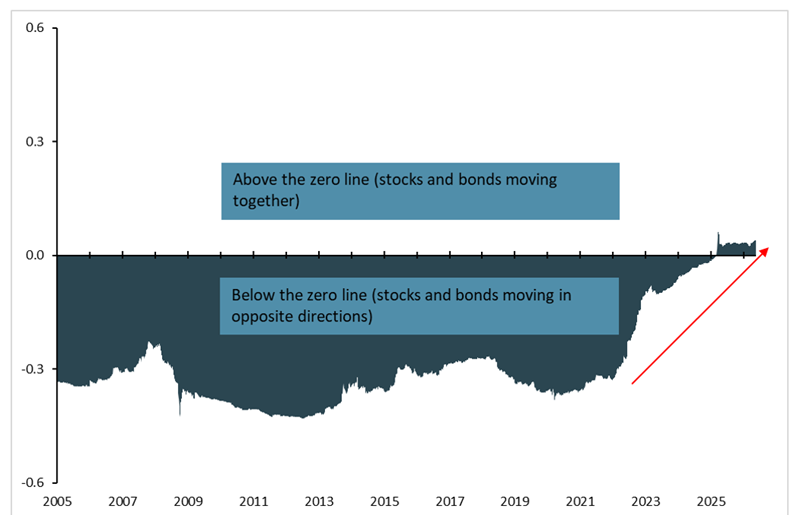
Indexes are unmanaged and not subject to fees. It is not possible to invest directly in an index. This material represents an assessment of the market environment at a specific point in time and is not intended to be a forecast or guarantee of future results. Source: Kestra Investment Management with data from FactSet. Index: S&P 500 and Bloomberg U.S. Universal. Data as of May 20, 2026.
The shift is a reminder that diversification is not about eliminating drawdowns. It is about building exposure to return drivers that do not all respond the same way to the same risks. In 2022, inflation became the common pressure point across both stocks and bonds, weakening the diversification benefit investors had come to expect.
That said, not all fixed income behaved the same way. Shorter maturity, higher quality exposures held up better, while longer duration assets were more sensitive to the rapid rate adjustment. Lower quality credit behaved more like equities as spreads widened, limiting its ability to offset equity losses.
For advisors, the lesson from 2022 is straightforward. Diversification must be built, not assumed. Fixed income positioning is a key part of that process.
Why Starting Yield Changes the Conversation
Following the Global Financial Crisis, fixed income faced a structural limitation. Yields were low, income was limited, and total returns depended more heavily on rates moving lower. That left investors with a smaller margin for error.
The setup today is materially different. The Bloomberg U.S. Universal Index yields approximately 5 percent, shifting the return profile back toward income and carry. That matters because coupon income is generally the more predictable component of bond returns.
For portfolio construction, this changes the math in two important ways:
- Income now drives a larger share of expected return, giving investors more cushion against price volatility.
- Higher starting yields can shorten the time needed to recover from drawdowns.
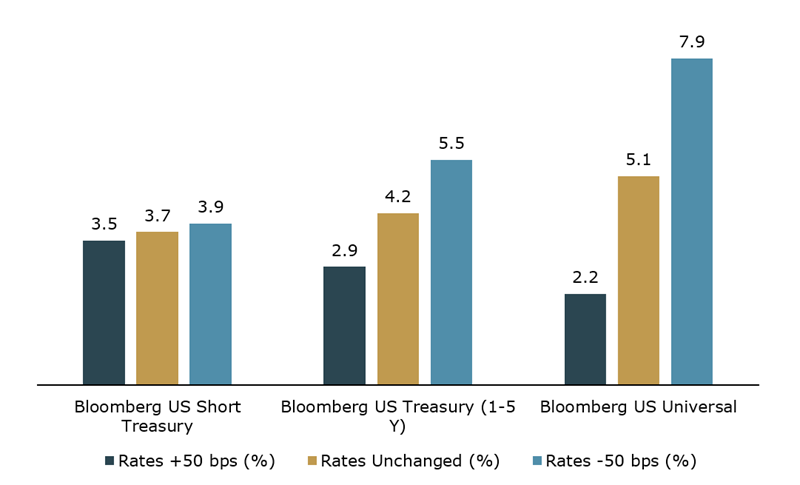
The benefit of higher starting yields becomes clearer when looking at potential 12-month outcomes across different rate environments. For example, the Bloomberg U.S. Universal Index currently has a coupon of roughly 5.1%. If an investor held the index for the next 12 months and rates were unchanged, that income alone would drive a return of approximately 5.1%. If rates declined by 50 basis points, the return would increase to nearly 8% as bond prices rose. But even if rates increased by 50 basis points, the starting yield would help cushion the price decline, leaving the investor with a positive return of roughly 2.2%.
Why Starting Yields Matter: The Yield Buffer
Estimated 12-Month Total Return Across Rate Scenarios (%)
Indexes are unmanaged and not subject to fees. It is not possible to invest directly in an index. This material represents an assessment of the market environment at a specific point in time and is not intended to be a forecast or guarantee of future results. Source: Kestra Investment Management with data from FactSet. Index: Bloomberg U.S. Short Treasury, Bloomberg U.S. Treasury (1-5Y) and Bloomberg U.S. Universal. Data as of May 20, 2026. Estimated total returns are calculated as yield to maturity minus (effective duration * change in interest rates), assuming a 12-month holding period and a parallel shift in the yield curve. Yield to maturity represents the annualized income component, while effective duration measures price sensitivity to changes in interest rates.
The takeaway does not require a precise view on rates. If yields hold steady, income still contributes. If growth slows and rates decline, duration adds potential upside. After years when bond returns depended heavily on falling rates, today’s higher starting yields create a more balanced return profile.
Volatility, Drawdowns, and Portfolio Durability
Volatility is part of investing. The more important question is whether a portfolio can remain durable when markets are under pressure. That is where fixed income plays an important role.
Bonds are not designed to eliminate volatility or prevent losses. Their role is to help moderate the path of returns, reduce reliance on equities, and give investors a better chance of staying invested when markets become uncomfortable. That distinction matters because how a portfolio behaves along the way matters just as much as the ending return. A strategy that looks appropriate on paper can still break down in practice if investors cannot stay with it through a difficult stretch.
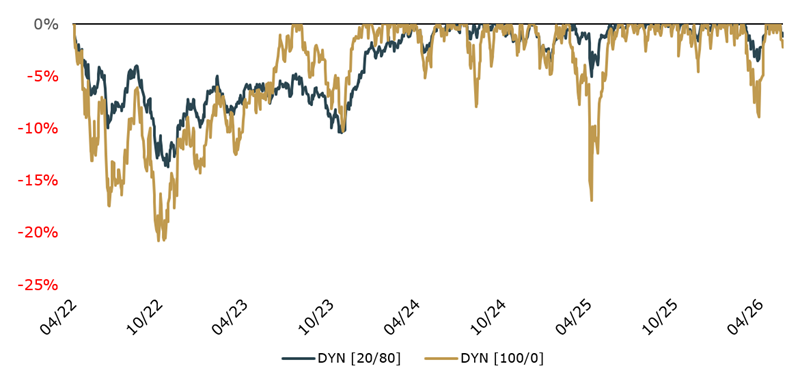
Drawdowns reinforce this point. A portfolio that falls less has less ground to recover and creates fewer moments where investors feel compelled to make changes at the wrong time. The impact is most visible during periods of market stress, where portfolios with fixed income have historically experienced shallower drawdowns.
Adding Fixed Income Has Historically Reduced Drawdown Depth
(4/1/2022 – 5/19/2026)
Indexes are unmanaged and not subject to fees. It is not possible to invest directly in an index. This material represents an assessment of the market environment at a specific point in time and is not intended to be a forecast or guarantee of future results. Source: Kestra Investment Management with data from FactSet. Reported performance represents Kestra IM seed capital account. Data as of May 20, 2026.
Portfolio Implications for Advisors
The discussion today is less about whether bonds belong in portfolios and more about how the exposure is built.
Fixed income is not homogeneous. Three components drive most outcomes: duration, credit quality, and sector composition. Each plays a different role, and each behaves differently depending on the market environment.
Duration
Duration measures how much a bond’s price is expected to change for a given move in interest rates. Bonds with higher duration tend to experience large price movements, while shorter-duration bonds are generally less sensitive.
This matters because the role of duration changes with the market environment. When inflation is the primary risk and rates are rising, shorter duration can help limit price sensitivity. When growth slows and rates decline, longer duration can provide potential upside.
In today’s higher-yield environment, investors do not need to rely solely on duration for return potential. Income can play a larger role in total return, while duration remains an important tool for managing rate exposure and portfolio resilience.
Credit Quality
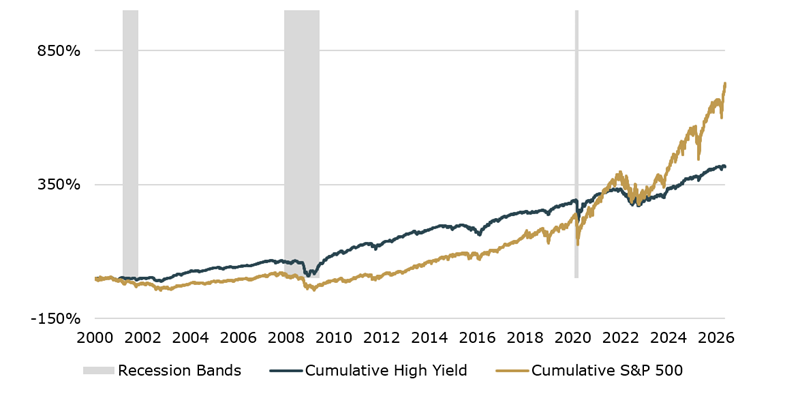
Credit quality determines how much economic sensitivity sits inside the bond allocation. Higher quality bonds have generally behave more defensively during periods of stress. Lower quality credit can offer higher income, but it often carries more equity-like behavior when spreads widen, meaning, when stocks decline, high-yield bonds tend to decline as well. Economic downturns expose this dynamic most clearly.
High Yield Has Historically Tracked Equities During Recessions
Indexes are unmanaged and not subject to fees. It is not possible to invest directly in an index. This material represents an assessment of the market environment at a specific point in time and is not intended to be a forecast or guarantee of future results. Source: Kestra Investment Management with data from FactSet. Index: S&P 500 and ICE BofA U.S. High Yield. Data as of May 20, 2026.
For investors, the question is not simply how much yield a bond allocation offers, but where that yield is coming from. Today, spreads remain relatively tight across most of the credit spectrum.
Sector Composition
Two portfolios with similar yields or durations can still behave very differently depending on their sector composition. Sector composition refers to how a portfolio is allocated across different parts of the fixed income market, such as Treasuries, credit, and securitized sectors.
Treasuries provide clean rate exposure, while corporate credit introduces spread risk that can become more correlated with equities during periods of market stress. Securitized sectors, including agency MBS, ABS, and CMBS, offer different sources of income and risk depending on structure, collateral, and liquidity.
Because these sectors respond to different drivers, diversification within fixed income can help reduce reliance on any single source of risk. The relationship between sectors is not uniform, which is why sector allocation remains an important part of portfolio construction, as illustrated in the correlation matrix below.
Fixed Income Sectors Do Not Always Move Together
Three-year correlations across major fixed income sectors
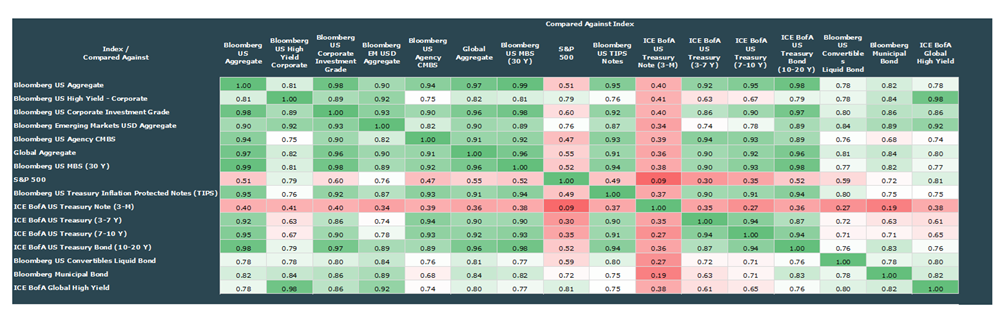
Indexes are unmanaged and not subject to fees. It is not possible to invest directly in an index. This material represents an assessment of the market environment at a specific point in time and is not intended to be a forecast or guarantee of future results. Source: Kestra Investment Management with data from FactSet. Index: Bloomberg U.S. Aggregate, Bloomberg U.S. High Yield – Corporate, Bloomberg US Corporate Investment Grade, Bloomberg Emerging Markets USD Aggregate, Bloomberg US Agency CMBS, Bloomberg Global Aggregate, Bloomberg US MBS ( 30Y), S&P 500, Bloomberg US Treasury Inflation Protected Notes (TIPS), ICE BofA US Treasury Note (3-M), ), ICE BofA US Treasury Note (3-7Y), ICE BofA US Treasury Note (7-10Y), ICE BofA US Treasury Note (10-20Y), Bloomberg US Convertibles Liquid Bond, Bloomberg Municipal Bond, and ICE BofA Global High Yield. Data as of April 30, 2026.
The broader point is straightforward: fixed income remains a core part of portfolio construction, but the details matter. Duration, credit quality, and sector composition determine whether the allocation is primarily providing income, diversification, downside protection, or equity-like risk in a different form.
Final Takeaway
Bonds are not designed to lead markets. They are designed to support portfolios when leadership breaks down.
Fixed income will not outperform in every environment, but a well-built fixed income allocation plays a critical role in keeping portfolios functional when conditions get difficult.
With both inflation uncertainty and growth risks still present, and yields reset at more attractive levels, fixed income is once again better compensated to serve the role it was built for.
Championships are not won on highlight reels. They are built in the trenches.
The opinions expressed in this commentary are those of the author and may not necessarily reflect those held by Kestra Advisor Services Holdings C, Inc., d/b/a Kestra Holdings, and its subsidiaries, including, but not limited to, Kestra Advisory Services, LLC, Kestra Investment Services, LLC, and Bluespring Wealth Partners, LLC. The material is for informational purposes only. It represents an assessment of the market environment at a specific point in time and is not intended to be a forecast of future events, or a guarantee of future results. It is not guaranteed by any entity for accuracy, does not purport to be complete and is not intended to be used as a primary basis for investment decisions. It should also not be construed as advice meeting the particular investment needs of any investor. Neither the information presented nor any opinion expressed constitutes a solicitation for the purchase or sale of any security. This material was created to provide accurate and reliable information on the subjects covered but should not be regarded as a complete analysis of these subjects. It is not intended to provide specific legal, tax or other professional advice. The services of an appropriate professional should be sought regarding your individual situation. Kestra Advisor Services Holdings C, Inc., d/b/a Kestra Holdings, and its subsidiaries, including, but not limited to, Kestra Advisory Services, LLC, Kestra Investment Services, LLC, and Bluespring Wealth Partners, LLC, do not offer tax or legal advice.